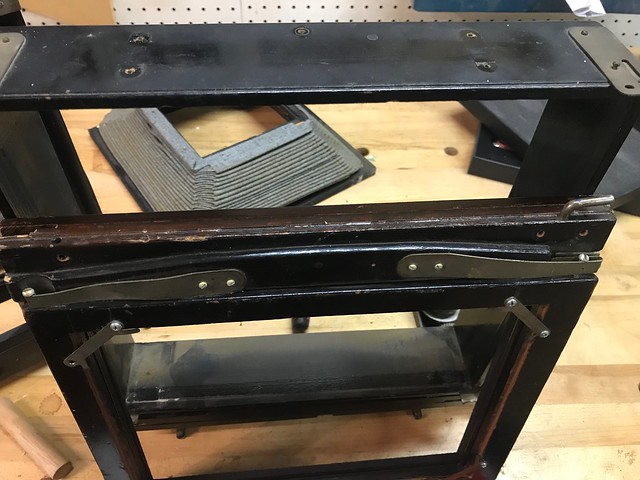
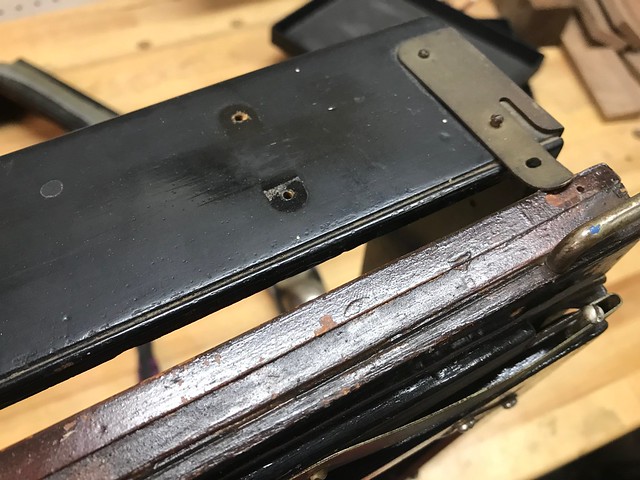
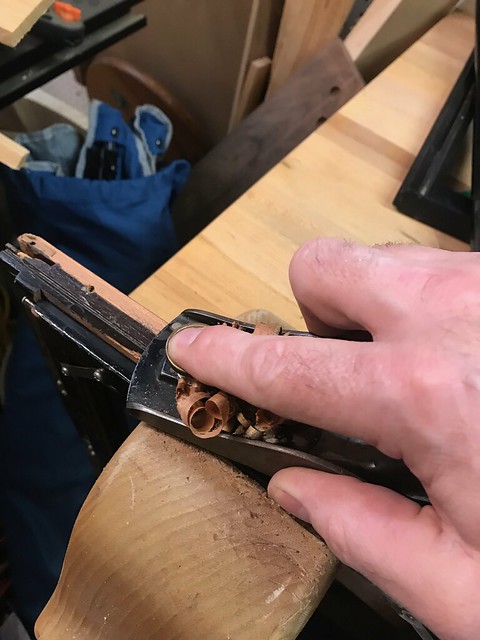
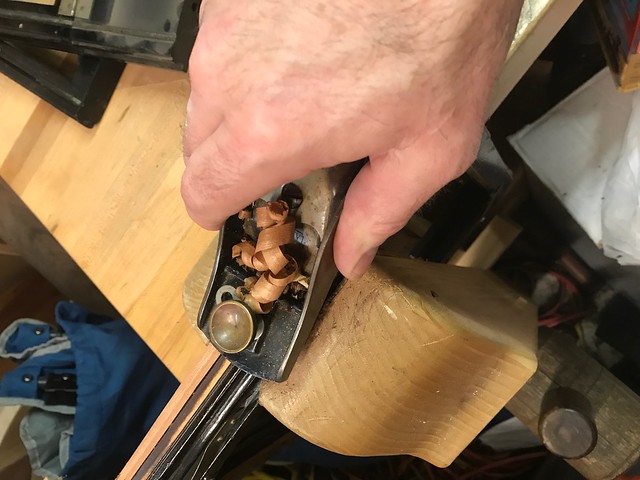
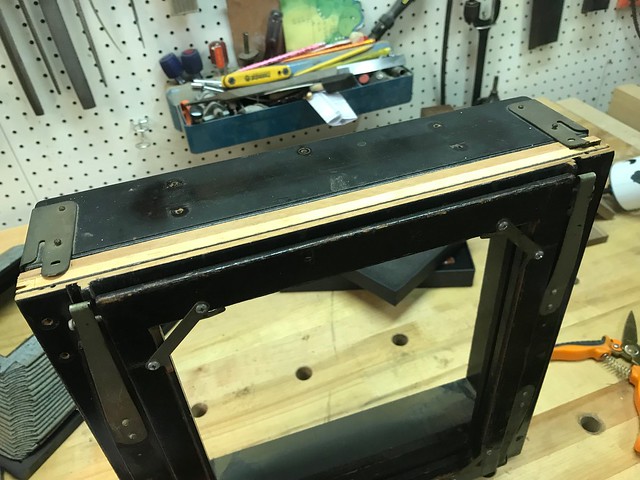
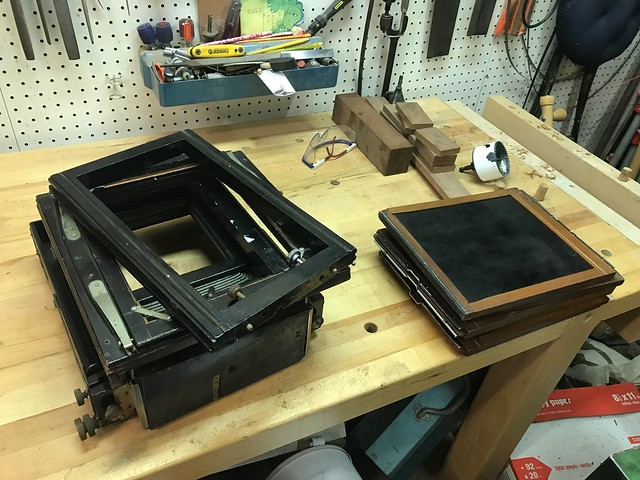
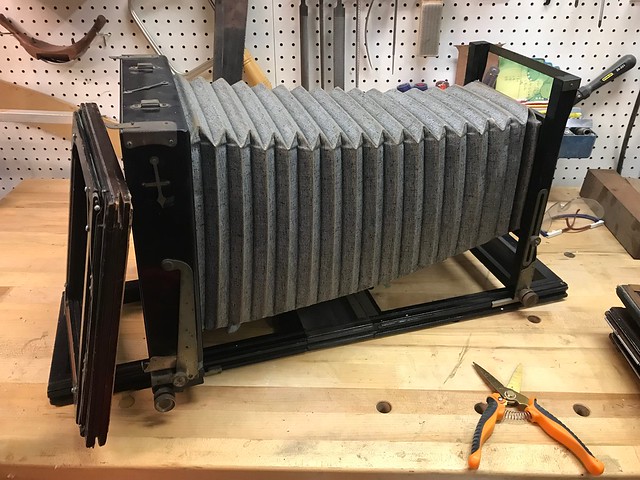
That’s all…

Well, I secured a full-time, paying position, so I’m officially out of the camera restoration game. I am no longer taking orders for fabrication or accepting custom work. It’s been fun, and I may do s’more on a personal basis as time allows, but fer now, there just aren’t enough hours in the day.

Not sure what this blog will evolve into now.

Thanks for the interest.

The home-brew pano rig…

Years ago, I converted a huge plate camera to 5×12″ service. I was infatuated with panoramas, and the 5×12 was feeding that. Unfortunately, the camera was heavy, unwieldy, and expensive to shoot. I sold it off, but still had a desire to shoot panos.

Someimte in late 2008, I started pondering on a pano head to use with my Canon 20D. They’re neat, look fairly easy to use, but were expensive, even on the used market. I had pieces of aluminum on the garage, and figured anything I’d make couldn’t be so bad as to be worthless, so I got working.

I can’t remember what design I borrowed, but the first rev of the home-brew pano rig turned out fairly well, and completely functional:

In use, everything was fine. I’d done a bit of research on entrance pupils and setting the thing up (which is lost in the ether that is my memory now) and I ended up with panoramas that needed little, if any, cropping. But the aluminum stock was thin, the camera set too high, and the mount a little insecure. All this made for a wobbly, slow rig to use.

Rev. 2 of the design came about with thicker aluminum, more care in placement of the entrance pupil (specific to the lens I was using, a 17-40L) and better hardware.
Rev.2

Rev.2

This was, and still is, golden. A joy to use, sturdy and stable. I got crazy shooting panos for a long time:

Even got the kids involved for some creative photo shooting. As usual, they were good at it:

17-40_DPHDR

hay_crop01a

I’ll admit to feeling stagnant lately. In looking for some large format gear in the drawer today, I pulled out the old pano rig. Made a few modifications to it – cut down some of the 1/4-20 bolts to make attaching the camera quicker – and even cleaned the sensor on the 20D. I think it’s time to take the rig out again. May be just the thing to pull me out of this rut…

Seneca View 8×10 – Front bellows frame…

After much hemming and hawing, I actually got a little work done today. Two things need to be fabricated on the 8×10 – a new front bellows frame (the camera was missing this when I bought it) and an extension rail. I scoured the shop for some time today, and finally found a piece of appropriately-sized oak to make the bellows frame. It needed dimensioning, which was done solely with the thickness planer. I didn’t take note of any dimensions, though, rather fitting the piece to the space needed:

Photobucket

After cutting the pieces to length (5-1/2″ each) I laid them out to make sure the opening would be sufficient:

Photobucket

The pieces are joined with my favorite half-laps. Quick to set up with the horizontal router table, though a little dicey cutting on thin pieces:

Photobucket

I ended up nibbling away the waste in small bites, taking four or five passes to cut the entire joint.

The joints, cut:

Photobucket

And with the pieces mated. Everything looks good.

Photobucket

I’m a big fan of polyurethane glues for most applications where strength and permanence is paramount. I always wet the surfaces a bit, as the glue needs moisture to cure. Small joints like these only require spring clamps to hold them tight while the glue sets:

Photobucket

After a few hours, I’ll remove the clamps and let the frame sit overnight. Poly glue creates a foaming squeeze-out which cures hard. It’s easily removed with a sharp chisel.

Now I need to measure exactly the final draw with the extension gear racks in place, and ship the frames off to Wales for bellows fabrication.

Seneca View 8×10 – Just when I thought it was over…

Okay, I’m all over the place these days. Was ready to get rid of the 8×10 project and buy a lens to cover 10×12. Found that I had an old process lens that’s insane-sharp and covers with room for tons of movement. Done. Then hit a crisis of sorts with large format in general: Becoming stale, not spending enough time actually shooting for creativity. So, I sold the Super Speedex and used some of the proceeds to purchase the Pentax 645, which gives me more creative options due to the availability of other lenses. Start scouting for another lens. Then spend a day contact printing 10×12 negatives. Find that I really enjoy having a traditional print in my hands, and that 10×12 is still too large for casual, spontaneous shooting. Want a new woodworking project – have a wine cabinet planned, but something shorter-term would be fun.

Re-enter the Seneca 8×10.

I’ve pulled a board of maple from the pile, which will become the rear extension rail. The woodworking is going to be pretty straight-forward. What’s going to be a (fun) challenge is the precision that must go into the alignment of the new parts with the old. Should keep me occupied for a little while.

So, the 8×10 is back on. Egad.

Getting to know the Pentax 645…

Earlier this week a new camera arrived: a Pentax 645 medium format SLR. Came equipped with the SMC-A 75/2.8, 120 insert, and a bunch of old film. I’d been looking for something new to try to get me out of a creative slump. All my large format shooting has started to look alike. Add to that the inherent cost, time, and hassle involved in shooting LF (or ULF), and I was beginning to burn out. Some folks on APUG suggested working in a smaller format for a while; I wanted the availability of different focal lengths, and found a good, used, 645.

I’ve put a few rolls through it already. One of just kids (go figure) yielded some nice shots of Maddie:
triptych

But today I was in Reading, so I drove to nearby Wyomissing to stroll a couple parks along the Tulpehocken Creek. One boasts the largest single-span covered bridge in the state; the other was a grist mill in centuries passed. I ran through a roll of Acros while there; some shots are presented below.

The restored Gruber Wagon Works:
img364

A closeup of a wagon wheel, through the Canon 500D diopter, which fits the SMC-A 75/2.8:
img363

Wertz’s Bridge:
img359

A web in a hole in the bridge:
img358

Some buildings at Gring’s Mill:
img357

A stitched pano from Gring’s mill:
img354

And a sluice gate at Gring’s Mill:
img355

I am LOVING this camera! I’m also, admittedly, a little glad for the respite from large format. I’m finding it liberating to just sling a camera over my shoulder and go. No planning, no hassle, no mess. There’s a place for that, but for now, I’m truly enjoying shooting again. And, I want a wider lens…

Seneca View 8×10 – Decisions, decisions…

Last week I came into a windfall buy of 10×12 FP4+, enough to keep me shooting for a long, long time. So, I’m feeling recommitted to the format, and want a lens with enough coverage to allow for some movements. Problem: No money. I’ve sold most all of the photographic chaff I had laying around. About the only thing left? The 8×10 Seneca View project camera. I know I’ll want an 8×10 again someday. I also know the 10×12 is an insane rig to carry around in the woods. But I don’t really feel like I have the luxury of maintaining both formats, even in project stages.

I also know the 8×10 would be worth so much more were it complete. But new bellows cost money, a new extension rail requires time I don’t seem to have. I fear I’m on the brink of forsaking this beautiful camera in pieces.

Decisions, decisions…

Seneca View 8×10 – Drilling and tapping rivets…

I seem to be in a perpetual state of stall with this camera. Odd, because I can’t wait to have it working. Ah, well.

Yesterday I bought some hardware bits to complete a tripod base plate for a client. While there, I bought a new #36 drill bit for my #6-32 tap, and a couple of 3/8″ #6-32 brass bolts. The rear box of the camera has been refinished and hardware reinstalled; all that was left was to drill and tap the side rivets and remount the box. I always get stuck mentally on this step for some reason.

So, today, I spent a grand total of 15 minutes doing the metalwork. Cut the remaining shafts off the rivets with a Dremel cut-off tool. Drilled carefully into the rivet heads. Tapped with the #6-32 tap. Installed the box.

IMG_1964

IMG_1965

Perfect fit. The rear standard is very nearly done. A change of direction on this rehab: I’m not polishing all the brass after all. Most of what I’d done before has aged in the interim; I’m not mentally in the same place about it anymore. Blame it on the 10×12. I just wanna shoot this, and the patina looks good. That said, I have a couple pieces on the rear box (the latch and the handle clips) that are very gross. It may only take a soak in Tarn-X to clean them up, but when they’re clean, the rear is done. Front standard is dusty, but otherwise in good shape.

IMG_1967

So, here’s the plan: I need to fabricate a new front bellows frame, then send the frames off to Sandeha so he can start fabricating the new bellows. I need to make a new rear extension bed. I have the gear racks, which (on closer examination) are a different tooth count, but same pitch, as the existing. I’ve run the pinions over the rack over and over, and they appear to work. I’m going for it. When I confirm that it’s working, Sandeha will start the bellows, which will draw about 27″ total. New handle and lensboards, and install the bellows when they get here. Finally, this camera is moving forward.

Of course, this is all on immediate hold, until I complete the tripod base plate for the client. Time to get busy.

The Ansco Super Speedex…

I’ve recently (well, several weeks ago) reacquired the 6×6 folder bug. Picked up several Ansco/Agfa folders, fettled them, played with them, and ended up selling them. It was fun, but reminded me that I have little tolerance for uncoupled rangefinders, and no tolerance for scale focus cameras. I was stuck.

For a brief time, I pondered giving up on large format for the time being (long story…) and thought to myself that I’d really need a decent carry-around camera for snapshots and grab shooting. Checked PayPal and had some extra money there; got to thinking about an Agfa Super Isolette, or the American version, the Ansco Super Speedex. Truly a pinnacle of folding camera design, I started trolling for one. Posted WTB ads here and there, but nothing substantial came up.

Fast forward a week. A “FT” ad was posted on APUG, listing an Ansco Super Speedex. I PM’d the seller, and an accord was reached. The camera arrived promptly.

Ansco Super Speedex...

For those not familiar with this camera, it’s an amazing piece of engineering. Truly the top-of-the line for Agfa/Ansco, and arguably for the design as a whole at the time. Unit focus, coupled rangefinder, automatic film loading and frame counting. Equipped with a reportedly reformulated, coated 75/3.5 Solinar lens. It’s a wonderful camera. There are interlocks galore: Shutter and counter don’t operate without film loaded; door won’t fold with the lens extended; twisting film lock knobs on the bottom of the camera won’t twist unless the camera back is open.

The camera was aces. Shutter worked flawlessly, and I had the seller run a roll of film through it ahead of time to check the automatic film loading and frame counting. Everything checked out, except for the focus mechanism. Stuck like cement. I’ve dealt with this before on other Ansco unit-focus cameras, and usually can free the focus with heat from a hair dryer. But this one was stuck. Wouldn’t budge. Tried repeated applications of heat, solvents, you name it. Nothing worked. And, in the end, I decided that – for once – this was a camera too valuable for me to booger up with my inexperience. I sent the camera off to Jurgen Kreckle of certo6.com fame. He gave me a very reasonable quote, and because he was currently working on a Super Isolette, he worked mine at the same time. Turn around was amazing, and he did a top-notch job. The camera returned with the focus CLA’d, smooth and buttery. So now, the camera is in completely optimal working order.

I initially shot nothing but 400 speed film in it, mainly to allow faster shutter speeds so my inadequate hand-holding didn’t induce blur. And I’ve gotta say – I hate 400 speed films. There’s enough grain inherent (at least in the films and developers I’ve been using) that true sharpness is elusive. I was getting pretty decent results from Ilford Delta 400 in HC-110 dilution H, but still not as blistering-sharp as I’d hoped for. Then I loaded a roll of Acros…

The difference was night and day. No perceptible grain, incredible sharpness, wonderful tones. Amazing. I’ve shot mostly just snapshots of the kids with the Super so far, but here’s a test shot from a recent photo walk with my son:

img218

A crop from that image shows the detail in the negative:

Photobucket

I am happy.

So, the Super is now my travel camera. I’ve accumulated a bunch of 100, 160, and 400 films in B&W and color to feed it. And I’m looking for excuses to shoot it.

Oh, and I dragged out the 4×5 to shoot a proper portrait of it:

Ansco Super Speedex...

This camera’s a keeper. And I think I’ve satisfied my folder Jonesing…

Star Camera Company 10×12 – Bellows installed, ready to rock!

Yesterday, the bellows arrived from Wales.  Unfortunately, I wasn’t here to sign for them, so I had to wait until this morning to pick them up. But they were in pristine shape, well-packed, and ready to install.

The installation took about 25 minutes. The front of the bellows attach by a frame; Sandeha attached the bellows to the frame and trimmed the end with felt to help create a secure light seal. I screwed the frame back into the original holes. Easy.

The rear of the bellows attach by about 8 gazillion little 1/4″ tacks. I did a little trimming to make a perfect fit and started tacking. I have 25 in place now to hold things; as time allows, I’ll go back and install more of the tacks. But it’s secure and light-tight now.

Placed atop the Ries, it’s ready for action.

IMG_1619

IMG_1622

IMG_1620

I’m ordering HC-110 today, and some 11×14 paper. I’m hoping to take this on a hike early next week.

Format choice – hypomaniacal ponderings…

Okay, I’m heading back into a philosophical slump again. Case in point: This photo, posted a few days ago.

Seed pod...

Just for kicks, I shot the same scene on my Canon 20D with a Sigma 105/2.8 macro lens, toned in CS5:

Photobucket

I’m disappointed in the second shot, mainly because it makes me question the first.

The large format shot had plenty of rear swing, keeping the out-of-focus rendering of the rest of the branch consistent. The use of a Petzval lens dropped the depth of field down to a razor edge, and created a luscious bokeh. Those familiar with such things are likely to see them. But when I show these two images to non-photographers, they unanimously choose the digital version.

Depth of field on the digi-shot is created strictly by aperture, not by movements. But is the shot any less successful? Not to me. At least, the small differences, selectively perceptible, don’t justify the time, effort, and expense of the large format version.

Don’t get me wrong – I LOVE shooting large format. But I’m afraid I’m becoming process-driven, rather than result-driven. I believe there’s a place for both; I’m falling into the habit, though, of favoring one indiscriminately. The seed pod shot is an example.

Another data point: I recently rediscovered my shelved Nikkormat FT2 and its small stable of Nikkor glass. I joyously shot a roll of film on the kids yesterday, metering carefully and shooting from a tripod. Took the film to CVS today, and the results were lackluster. Very ho-hum. And these were shots I’d usually try on large format. When the film ran out, I grabbed the 20D and a Super Tak 135/3.5. Shot of a bunch of frames in rapid-fire mode. Cherry-picked the best, converted it in CS5 to duotone, and I now have a fantastic image that I’ll have printed large. With none of the hassles or gyrations I’d generally put myself through. The results were the priority, not the process.

I’ve always known that there’s a place for digital, a place for 135, a place for 120, a place for the large formats. But my limited attention span keeps me from making a conscious decision about which is appropriate for a given scene. Which tells me I shoot too much from the hip; I need to be more considered in my shooting. Which may actually get me out of my creative rut. I’ll be shooting snapshots and even some setups of the kids with the 20D. When the 10×12 is operational, I’ll be taking it to a local waterfall to shoot the scene with plenty of tilts. And the result will be contact printed, and should yield a crystal clear print. But the gray areas in between are going to need some thought.